
Dr Biji Kurup


(CET 1991 Civil)

Biji is a director and principal consultant of water and sustainability engineering of Environmental Engineers International Pty Ltd, an Australian based consulting firm. Her areas of expertise include industrial ecology, industrial symbiosis, industrial by-product utilization, sustainability analysis, wastewater treatment and waste management. Her qualifications include; PhD in environmental engineering from Curtin University in Australia, Master of Engineering from UNESCO-IHE, Delft, The Netherlands, M. Phil in Futures Studies from University of Kerala and B. Tech in civil engineering from CET.
Previously Biji was Planning Manager and Senior Engineer of Water Corporation of Western Australia. She commenced her engineering career as a trainee engineer with Kerala State Electricity Board.
Industrial symbiosis
Industrial symbiosis is a term used to explain the collaboration between traditionally separate industries in a collective approach to competitive advantage involving physical exchange of materials, energy, water, and/or by-products. The keys to industrial symbiosis are collaboration and the synergistic possibilities offered by geographical proximity.
Through collaboration, industries can strive for a collective benefit, which is greater than the sum of individual benefits that could be achieved by acting alone. This collaboration can lead to social and economic relationships among the participating industries and community. When the concept of industrial symbiosis is realised and practiced in an industrial area, one can argue that there is a possibility of achieving economical, social and environmental benefits.
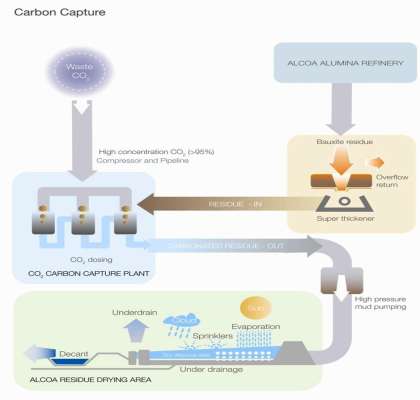
One example of Industrial symbiosis is the Residue Carbonation Project by Alcoa Australia and CSBP in Kwinana, Western Australia. Alcoa processes bauxite for alumina production, the residue retains some alkaline liquor and requires long-term storage and careful management to prevent contamination of natural water resources. Mixing the CO2, emitted from the nearby CSBP ammonia plant into residue reduces its pH level to the levels found naturally in many alkaline soils, where it can potentially be re-used in road base, building materials or soil amendments as well as a product for phosphorus stripping from contaminated waters such as stormwater and wastewater.
The Kwinana carbonation plant locks up 70,000 tonnes of CO2 a year, the equivalent of taking over 17,500 cars off the road. The project resulted in using a waste product (CO2) of one industry for use as a raw material for producing a useful resource from the hazardous waste product of another industry, thus benefitting the community. This clearly shows that industrial symbiosis has social, environmental and economic benefits.
Join CETAA... Its Free
If you are an alumni of CET, and you passed out in the year 2000 or before, you can join CETAA for Free ! Others will be added automatically.